
M Stout M Stout

Repair or Replace? An Honest Framework for Your Furnace or AC

Repair or Replace? An Honest Framework for Your Furnace or AC.

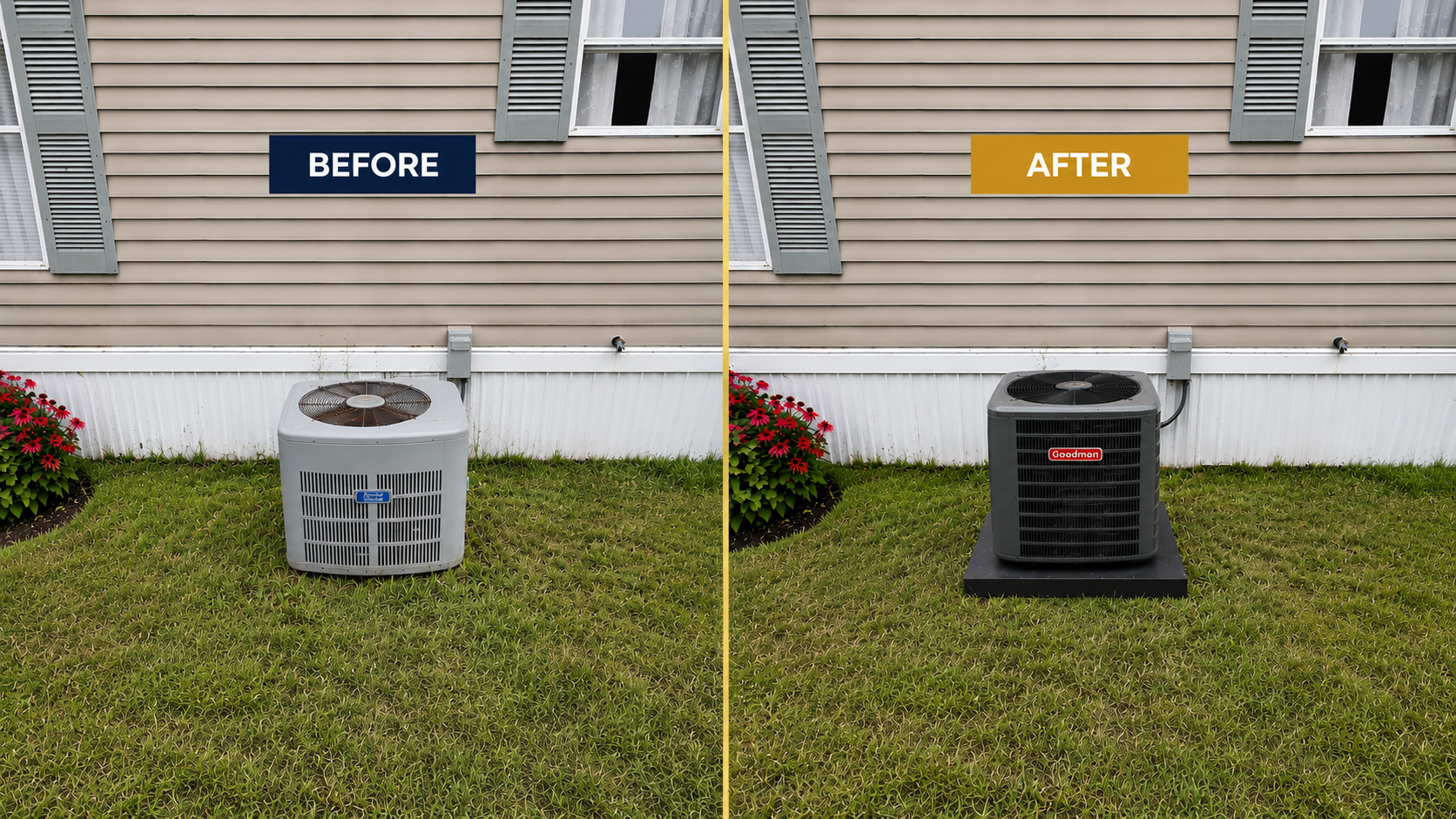
When your heating or cooling system breaks down, the company you call has enormous power over what you do next. They can tell you it's a quick fix — or they can tell you it's time for a $12,000 replacement. And too often, which answer you get depends on whether that technician is working for you or working toward a sales quota.

So here's the honest version. This is the same framework we use in the field, laid out so you can make the call yourself before anyone hands you a quote.

When your heating or cooling system breaks down, the company you call has enormous power over what you do next. They can tell you it's a quick fix — or they can tell you it's time for a $12,000 replacement. And too often, which answer you get depends on whether that technician is working for you or working toward a sales quota.

So here's the honest version. This is the same framework we use in the field, laid out so you can make the call yourself before anyone hands you a quote.

Start with one number: the age of the system

Age is the single most important factor, and it's the one homeowners most often don't know.

  • Furnaces and air conditioners that are installed properly and well-maintained usually last 15 to 18 years.

  • Heat pumps that are installed properly and well-maintained run closer to 10 to 15 years in our West Michigan climate.

If your system is comfortably inside that window and well-maintained, the math almost always favors repair. If it's near or past the end of its expected life, repair becomes harder to justify — not because the company wants to sell you something, but because you'd be putting money into equipment that's going to need more money soon.

Don't know how old yours is? Look for the manufacture date on the data plate, or the serial number — most brands encode the year in it. A good technician will tell you straight.

The cost test that cuts through the noise

There's a simple rule of thumb that's served homeowners well for decades:

Multiply the repair cost by the age of the system. If the result is over $5,000, lean toward replacement. If it's well under, lean toward repair.

A $300 repair on a 6-year-old furnace? That's 1,800 — fix it without a second thought. A $1,500 repair on an 18-year-old system? That's 27,000 — you're pouring money into something on its way out.

A second sanity check: if a single repair costs more than about a third of a new system, replacement usually makes more sense. One pricey fix on old equipment is rarely the last one.

The things that genuinely tip it toward replacement

A few situations move the needle on their own, regardless of the math:

  • Old refrigerant (R-22). If your AC is old enough to run on R-22, that refrigerant has been phased out and is now expensive and hard to source. A refrigerant-related repair on an R-22 system can cost a small fortune for a system that's already obsolete. This is a legitimate replace signal.

  • A cracked heat exchanger. A cracked exchanger can allow combustion gases to escape where they shouldn't. On an older furnace, replacement is almost always the right answer. This one isn't really about money; it's about doing the job right.

  • Repeated breakdowns. If you've called for service two or three times in the last couple of seasons, you're not buying repairs anymore — you're renting reliability you no longer have.

  • Rooms that never feel right. If half your house is always too hot or too cold and the system is aging, you may be patching a unit that was never going to keep up.

The things that DON'T automatically mean replace

This is the part the quota-driven shops skip:

  • A single failed part on a newer system. Capacitors, igniters, flame sensors, blower motors — these are normal, fixable wear items. A bad part on a 7-year-old furnace is a repair, full stop.

  • "It's just old." Age matters, but a well-maintained 14-year-old system that's running fine and had one cheap repair doesn't need to go to the landfill yet.

  • An efficiency pitch alone. Newer systems are more efficient, and that's real — but the energy savings rarely pay back a premature replacement on their own. Efficiency is a nice bonus when you're already replacing for other reasons. It's a weak reason to replace a system that's otherwise got good years left.

If someone's leading with "you'll save so much on your energy bills" as the main argument to replace a system that still works — slow down and get a second opinion.

How an honest company should handle it

When we look at a repair-or-replace decision, you should expect:

  1. The actual age and condition of your system, told to you plainly.

  2. The repair option on the table — even when replacement might be the better long-term move, you deserve to hear both.

  3. The real cost of each path, so you can weigh them yourself.

  4. No pressure to decide on the spot. A failing system is stressful. A company worth trusting gives you the facts and lets you breathe.

Sometimes the honest answer really is "replace it" — and when it is, we'll tell you why and back it up. But plenty of the time, the right answer is a $250 fix and a reminder to schedule maintenance. We'll tell you that too, even though it's the smaller ticket.

The way we see it, our job is to give you the information and all the available choices. It is not to make that choice for you. Whatever you decide, we're proud to help.

That's the difference between a company that answers to you and one that answers to investors.

---

Got a system acting up and not sure which way to go? Prime Comfort Heating and Cooling will give you a straight answer — repair or replace — with no pressure either way. Locally owned, serving the greater Grand Rapids and West Michigan area. Call 616-345-8136 or visit hireprimecomfort.com.

Elevating West Michigan's comfort, one home at a time.

Read More
M Stout M Stout

The Quiet Takeover: What Private Equity Is Doing to Your Local HVAC Company

There’s a good chance the heating and cooling company you’ve trusted for years isn’t owned by the family whose name is on the truck anymore.

It might be owned by Blackstone. Or Goldman Sachs. Or a fund you’ve never heard of, run out of an office two time zones away, that bought the place, kept the logo, and changed everything about how it treats you.

There’s a good chance the heating and cooling company you’ve trusted for years isn’t owned by the family whose name is on the truck anymore.

It might be owned by Blackstone. Or Goldman Sachs. Or a fund you’ve never heard of, run out of an office two time zones away, that bought the place, kept the logo, and changed everything about how it treats you.

This isn’t a conspiracy theory. It’s the single biggest shift happening in the trades right now, and most homeowners have no idea it’s going on. So let’s talk about it plainly — what’s happening, why, and what it means the next time your furnace quits in January.

The numbers tell the whole story

A few years ago, private equity barely touched residential HVAC. In 2023, financial buyers accounted for roughly 8% of HVAC company sales. By 2024 that jumped to 23%. In the first half of 2025, private equity was behind about half of every HVAC business that changed hands — an 88% increase in deal activity in a single year.

These aren’t small deals, either. In early 2026, Blackstone agreed to pay around $2.5 billion for one residential HVAC, plumbing, and electrical platform — roughly 18.5 times its annual earnings. A few months earlier, Goldman Sachs bought a majority stake in another for about $1.7 billion. When the largest money managers on earth start writing billion-dollar checks for companies that fix air conditioners, you should pay attention to why.

And here’s the part that hits closest to home: the Midwest — Michigan included — is a prime target. We’re a heating-dominant market with aging equipment and steady replacement demand, and acquisition prices here are lower than in the booming Sun Belt. Translation: the funds see West Michigan as cheap inventory.

The playbook isn’t a secret

Private equity isn’t evil. It’s just doing exactly what it’s designed to do, and once you see the pattern you can’t unsee it:

  1. Buy a solid, established local company — usually one with a great reputation and an owner ready to retire — for 4 to 5 times its earnings.

  2. Bolt on a bunch of smaller shops in the same region. Keep the names and the trucks so customers don’t notice.

  3. Squeeze. Standardize pricing upward, push aggressive sales quotas, cut costs, lean on the loyal customer base the old owner spent decades building.

  4. Sell the whole bundle after 3 to 7 years for 8 to 12 times earnings.

That gap — buying small companies cheap and selling the combined giant for double the multiple — is the entire business model. The HVAC work is almost incidental. You are not the customer in that equation. You’re the recurring revenue.

What it actually feels like as a homeowner

In fairness, the big platforms do some things well. They get volume discounts on equipment. They can offer technicians better benefits and training. None of that is the problem.

The problem is what happens after the spreadsheet takes over:

  • The hard sell shows up. When technicians are handed sales quotas, a $400 repair turns into a $20,000 “you really should replace the whole system” conversation. The pressure isn’t an accident — it’s the strategy.

  • Prices climb. Consolidated pricing models exist to maximize per-ticket revenue, not to give you the fair number. The diagnostic fee, the markup, the “membership” — it’s all engineered.

  • Service gets thinner. Local decision-makers get replaced with corporate managers chasing quarterly numbers. The people who knew your house and your system move on, and the relationship that made you trust them in the first place quietly disappears.

  • The good techs leave. When cost-cutting hits wages and culture, the best tradespeople walk — and your service quality walks with them.

You usually can’t tell from the outside. Same name. Same colors. Same friendly logo. The change is in the incentives, and you only feel it when you’re standing in your kitchen being told your perfectly fixable furnace needs to go.

Why we stay independent on purpose

I spent 25 years in this trade — ten of them in the field, the rest in management and sales — before starting Prime Comfort. I’ve watched good companies get bought and hollowed out from the inside. That’s not a future I’m interested in.

Prime Comfort is independent, and it’s staying that way. No fund owns us. No quota tells me to upsell you on a system you don’t need. When you call, you’re talking to a local company that has to look you in the eye at the grocery store, not a portfolio entry on someone’s balance sheet.

That’s the whole reason we say Straight Talk, Every Time and No Pressure, Ever — and mean it. When nobody’s pressuring us to hit a number, we’re free to just tell you the truth: fix it when it makes sense to fix it, replace it when it makes sense to replace it, and never the other way around.

How to protect yourself

Whoever you call, ask two questions before they touch your system:

  1. Are you locally owned, or are you part of a larger group?” A straight answer tells you a lot.

  2. “Can you show me the repair option before we jump to replacement?” Watch how they react. If “repair” isn’t on the table, you know what’s driving the conversation.

The consolidation wave isn’t slowing down. But you still get to choose who works on your home — and you can still choose someone who answers to you instead of to investors.

___________________________________________________________________________________________________________________________

Prime Comfort Heating and Cooling is a locally owned, independent HVAC company serving the greater Grand Rapids and West Michigan area. No private equity. No pressure. Just straight answers. Call us at (616) 345-8136 or visit hireprimecomfort.com. Elevating West Michigan’s comfort, one home at a time.

Read More