
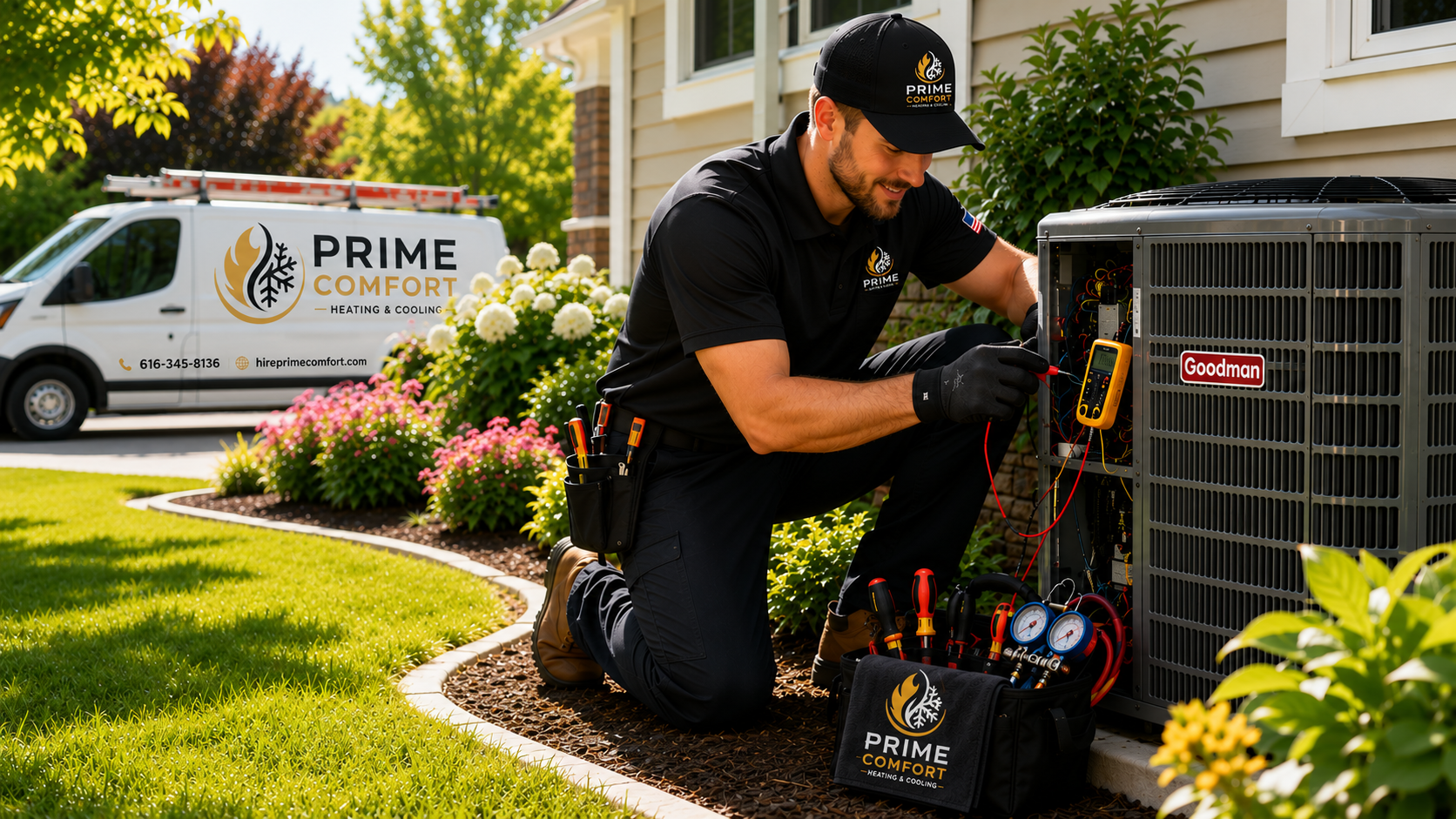
ROUTINE MAINTENANCE
Real Maintenance.
Not just a check-up.
Most companies send someone to glance at your system, tick a box, sell you stuff, and leave. We actually do the work — cleaning, flushing, tightening, and tuning the equipment that keeps your West Michigan home comfortable all year.
A checkup looks. Maintenance does.
“Tune-up” has been watered down to mean a quick visual once-over. That’s not maintenance — it’s a sales call with an agenda. Here’s what sets a real Prime Comfort visit apart.
The typical “check-up”
A look, then a quote.
Glance, read the thermostat, snap a few photos (~ 15 minutes)
Then run through a list of things to sell you (30 - 45 minutes)
You left feeling sold, not with a cleaner system
They spend 2-3 times longer pitching a sale than they spent “maintaining” the system.
A Prime Comfort visit
Hands on the equipment.
Coils washed, compartments cleaned out
Compressor, motors, contactor, and capacitors tested
Refrigerant charge and airflow verified
Burners and flame sensor pulled and cleaned
Heat exchanger camera-inspected for safety
Honest findings — repairs only if you truly need them
Why maintenance matters
A system that’s actually cared for runs cheaper, last longer, and breaks down far less.
Lower energy bills — clean coils and proper airflow let the system hit the thermostat without working overtime.
Fewer surprise breakdowns — most no-heat and no-cool calls trace back to wear we catch yearly.
Years more equipment life — maintained equipment can outlast a neglected system by a third or more.
Safer, cleaner air — we inspect combustion and the heat exchanger and keep dust and debris out of your air.
Warranty protection — most manufacturers require documented annual maintenance — we keep the records.
Front of the line — members get priority with our promise to be there within 24 hours of your call, or get $100 off the repair.
The two-season rhythm
Your plan includes two real maintenance visits, timed so the cooling system is ready for summer, and the heating is ready for the cold.
Spring/Summer - Cooling — Air conditioning tune-up
Wash the outdoor coil — not just a hose rinse
Clean out the compressor and electrical compartments
Test the compressor, fan motor, contactor, and capacitors
Clear the condensate drain line
Check refrigerant charge and confirm airflow
Fall/Winter - Heating — Furnace tune-up
Pull and clean the burners and flame sensor
Camera-inspect the heat exchanger for safety
Test all safety controls and motors
Dust out the cabinet
What we actually do
These aren’t inspection points we eyeball and check off. They’re tasks we perform, with our hands on your equipment, every visit.
Cooling system — Spring/Summer
Wash the outdoor coils — a real wash, not just a rinse with a hose, so the coil can shed heat. We’ll even clean the indoor coils if they’re accessible.
Clean the compressor compartment — clear out the leaves and debris that choke the unit.
Clear the electrical compartment — cobwebs and other nasty stuff out of where the wiring lives.
Clear the drain line — head off the clog that causes most summer water leaks and shutoffs.
Test the compressor — the heart of the system, checked to confirm it’s running right.
Test the fan motor — make sure it’s moving air and isn’t on its way out.
Test the contactor — the switch that takes the most wear every time the system cycles.
Test the capacitors — the weak part behind most no-cool calls.
Confirm proper airflow — so the system actually cools the way it should.
Check the refrigerant charge — verify it’s correct and not slowly leaking.
Heating system — Fall/Winter
Pull and clean the burners and flame sensor — the most common reason a furnace short-cycles or won’t stay lit.
Dust out the cabinet — clear the debris that builds up inside the furnace over a year.
Test all safeties and motors — limit switches, controls, and the blower, so the system always fails safe.
Camera-inspect the heat exchanger — a borescope look inside for cracks or holes that can leak combustion gases, so we catch an unsafe situation before it’s ever dangerous.
Confirm proper airflow — so the system actually heats the way it should.